Related games











Published on: October 2026
Updated on: October 2026
Game technology: HTML5
Platforms: PC, Phone, Tablet
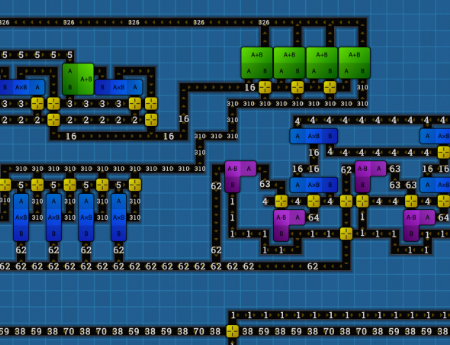
Beltmatic is a factory-building game where numbers act as resources and mathematical operations form the production system. There is no story, characters, or narrative campaign. The player explores a large map containing number deposits, extracts those values, transports them with conveyor belts, combines them in machines, and delivers the required results to a central Hub. Each new target turns into a production problem: find useful starting numbers, decide which operations will create the requested value, and construct a factory capable of producing it continuously.
Building Mathematical Factories
Extractors are placed on numbered locations and send their output onto belts. Those belts can lead directly to the Hub or into operators that combine two inputs. Early factories begin with addition, while later progression unlocks multiplication, subtraction, division, and exponentiation. Bridges allow belts to cross without mixing their contents, and storage buildings can hold large quantities of a particular number.
Operators and Production
Every operator follows a specific mathematical rule, so production lines can be connected together to create increasingly complex values. The main systems include:
· Adders that combine two numbers into their sum;
· Multipliers that produce the product of two inputs;
· Subtractors where input order affects the result;
· Dividers that output a quotient and remainder;
· Exponentiators that raise one input to the power of another;
· belts, bridges, extractors, storage, and the central Hub.
New machines are introduced gradually as the player advances through levels.
Levels and Expansion
Beltmatic uses numbered levels based on production targets rather than separate maps or stages. To complete a level, the player must deliver a required quantity of a specific number to the Hub. Early milestones unlock basic extraction upgrades and the Adder, while later levels introduce the Multiplier at Level 7, Subtractor at Level 13, Divider at Level 16, Exponentiator at Level 19, and Storage at Level 22.
As targets become larger, old production lines can be reused instead of rebuilding everything from the beginning. Players can connect existing outputs to new operators, expand farther across the map, and improve machine speeds through upgrades. There are no enemies, combat encounters, or time-limited missions, so the challenge comes from designing efficient layouts and maintaining enough throughput. Progress depends on turning increasingly complicated calculations into automated conveyor networks that continuously deliver the required numbers.
